
Yield Earthquake: US 30-Year Treasury Bonds See Their Biggest Weekly Gains in More Than Four Decades
The US bond market has just had a tumultuous week, with the 30-year Treasury yield recording its biggest weekly gain since 1981. The escalating trade war and macro uncertainties have created an unprecedented wave of selling.
Wall Street Sell-Off
Shortly after President Donald Trump's new tariffs took effect, financial markets were thrown into turmoil. Long-term bond yields surged as investors fled the stock market, sending S&P futures down 2%, while crude oil plunged 21% in just a few days. Bitcoin lost support, sliding to a five-month low, while gold fluctuated before recovering slightly to $3,064 an ounce.
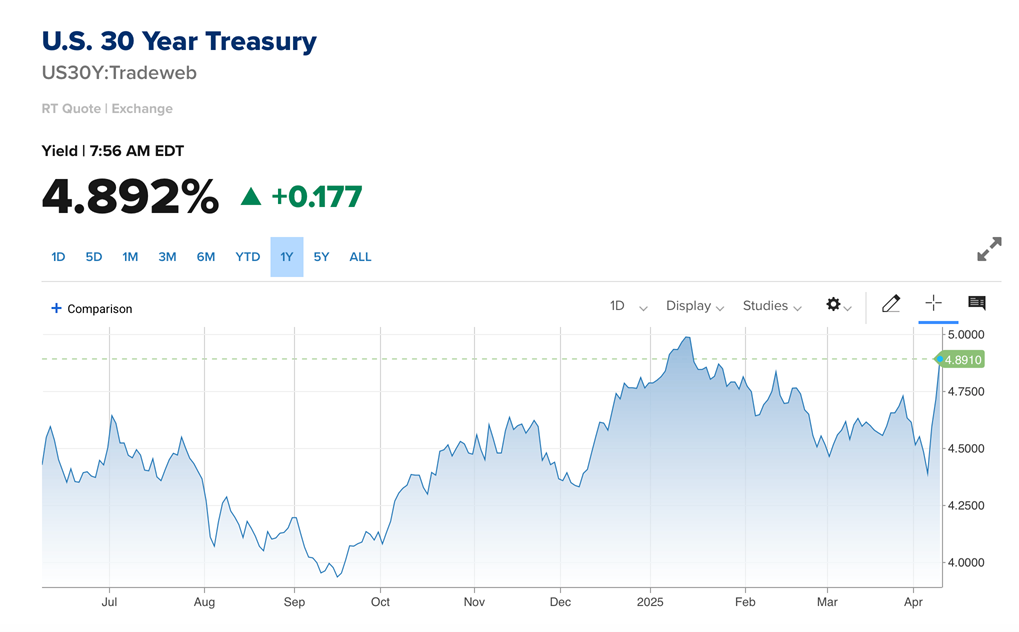
“We’re seeing a disorderly liquidation,” warns prominent macro analyst Jim Bianco. “The 30-year yield has risen 56 basis points in just three days—not because of interest-rate expectations, but because of panic.”
Highest Yield Since the Early 1980s Crisis
As of Wednesday morning, the 30-year Treasury yield was 4.892%, while the 10-year yield was 4.435%. The sharp move has sent money out of stocks and into bonds, which are considered safer in a volatile environment. The resulting downward pressure has spread across the stock market, hitting pension funds and long-term investors.
Basis Trading Cracks – A Time Bomb Detonates
One of the main reasons is believed to be the breakdown in basis trading – a popular strategy among institutional investors, in which they buy physical bonds and short the corresponding futures contracts. However, as yields rise too quickly, funding costs also rise, forcing them to liquidate positions at a dizzying pace, leading to a domino effect in the market.
Financial site Zerohedge calls this a “trillion-dollar liquidation panic,” referring to the enormous scale of money being drained from the system.
The Federal Reserve may have to intervene
Amid the chaos, analysts have begun to discuss the possibility of the US Federal Reserve (Fed) intervening. One possible scenario is to restart quantitative easing (QE), which is buying long-term bonds to stabilize yields. The Fed could also signal future rate cuts to calm markets.
Analyst account X (Oz) also pointed out a quiet but potentially decisive move: The Fed’s reverse repo reserve (RRP) has been reduced from a peak of $2.5 trillion to just $148 billion – equivalent to pumping a huge amount of liquidity back into the financial system.
Is the market on the line between panic and a new beginning?
“People still think we’re in the late stages of a bull market,” Oz wrote. “But when liquidity returns, the market could enter a period of intense growth – you’ll want to put on your helmet and be ready to chase green candles to historic highs.”
As investors continue to navigate the ebbs and flows of inflation data and global political tensions, many see the yield shock as more than a knee-jerk reaction – it’s the start of a whole new financial era.