
Rising US Treasury Yields: A Warning Sign for the Global Economy?
.jpeg)
A sharp rise in US Treasury yields is shaking global financial markets and raising concerns that the world economy may be headed for a new recession. As investors become more cautious amid monetary policy uncertainty, rising borrowing costs and geopolitical tensions, many experts warn that the bond market is sending out its most worrying signals since the 2008 financial crisis.
Bond Yields Hit Highest Levels Since 2007
On May 15, the yield on the benchmark 10-year US Treasury note hit 4.45%, while the yield on the 30-year bond topped 5% — its highest level in nearly two decades. The two-year yield also rose to 3.96%, highlighting the flattening of the yield curve and the narrowing spread between short and long maturities. Historically, such events have been a precursor to recessions.
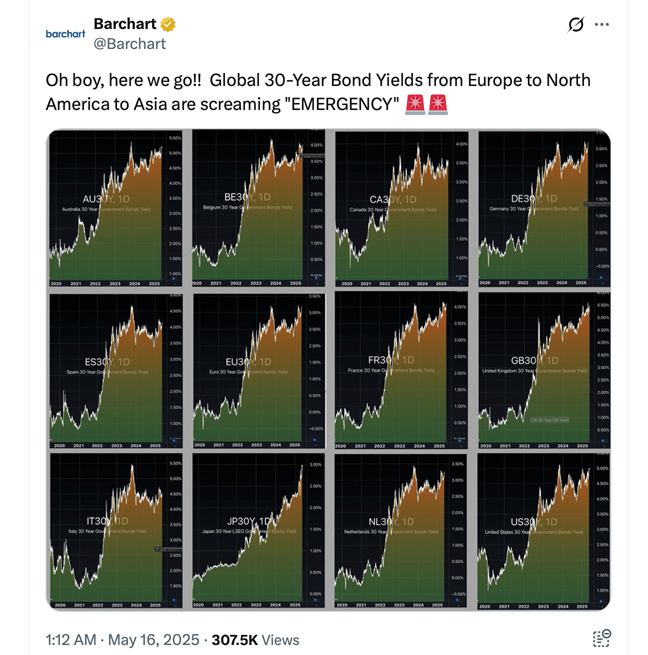
“The market is sending a clear message that it does not believe in a strong recovery in the U.S. economy,” said an analyst at Barclays. “The rise in long-term yields reflects doubts about the sustainability of sovereign debt and the effectiveness of monetary policy.”
‘Bond Vigilantes’ Return
The concept of “Bond Vigilantes” — investors demanding higher yields as a way to punish governments for irresponsible spending — is being revived as the 30-year yield rose to a 21-year high. According to the X Endgame Macro account, the trend is not driven by inflation or growth expectations, but rather a long-term rejection of sovereign debt.
“We are witnessing the beginning of a structural adjustment. No one believes in unlimited monetary easing anymore,” the account wrote. “High yields are not just higher borrowing costs; they are a sign of distrust.”
Global impact
Government bond yields are also climbing in many other countries. In the UK, Australia and Japan, 30-year yields are approaching or surpassing multi-year highs. Japan’s 30-year bond has hit a 21-year high, reflecting global pressures on fiscal and monetary policy.
Emerging economies, meanwhile, are at risk of capital outflows as investors seek safe haven in US bonds. Countries with dollar-denominated debt, such as Türkiye and Argentina, are particularly vulnerable to currency devaluation and liquidity crunches.
Rising Borrowing Costs and the Rippling Effects
The average 30-year fixed mortgage rate in the U.S. is now around 7%, according to the Federal Reserve, adding to the financial burden on households and businesses. Auto loans, consumer loans, and corporate debt are also becoming more expensive — weakening consumer demand and investment.
At the same time, the U.S. stock market has seen sharp corrections as money has shifted into bonds. Some experts say this reflects a defensive mood, while others worry that the bond shock could be a prelude to a prolonged recession.
Central banks face a dilemma
The Federal Reserve is under dual pressure: on the one hand, it must keep interest rates high to control inflation, on the other hand, it faces the risk of slowing growth and soaring financing costs. The same dilemma is plaguing the European Central Bank and the Bank of England, especially as the Trump administration’s new tariffs add to inflationary pressures.
Markets Enter a Recalibration Period
Amid mixed signals from economic data, interest rates and geopolitics, the bond market is becoming the “most honest barometer” of the global economic outlook. Higher yields are more than just a number: they signal shifting expectations, confidence and the level of risk the market is willing to take.
“This is no longer a game of inflation or rate cuts,” said an expert at Morgan Stanley. “This is a time when the real value of money and confidence in sovereign debt are being tested.”
As yields continue to rise and global investors grow more cautious, one thing is becoming clear: the decisions made in the next few months will shape the global financial future for years to come.